
The Underserved Professional: Why Your Doctor Isn't Helping You With Your Home Recovery

The Underserved Professional: Why Your Doctor Isn't Helping You With Your Home Recovery
Written by: Lian Liu, MPH, RD, CDCES | Specializing in Cardiac & Menopause Nutrition. Reviewed and updated: June 2026.
> Direct Answer: The medical system is primarily designed for reactive medicine—stabilizing acute conditions during emergencies—rather than the proactive, customized management required for long-term lifestyle optimization. Because of a significant "implementation gap" in clinical practice, doctors often focus on primary markers while leaving nuanced day-to-day recovery plans to the patient's own initiative.
Disclosure: Some of the links below are affiliate links. This means if you click through and take action, I may receive a small commission (at no extra cost to you). This helps support the free content on this blog while I only recommend tools and foods I truly believe in for your heart health journey.
Robert sat on the edge of the exam table, the crinkle of the sanitary paper sounding loud in the quiet clinic. He had waited four months for this follow-up after his stent placement. He had a list of questions about his HRV, his return to high-intensity work, and the nagging fatigue he felt by 2 PM.
Ten minutes later, the cardiologist was halfway out the door. "Everything looks fine on the EKG, Robert. Your labs are stable. Let's follow up in six months."
If you are a high-performing professional trying to navigate recovery, you have lived Robert's story. You are technically "fine," yet you feel fundamentally unsupported.
The traditional healthcare system is a masterpiece of reactive medicine. It is unparalleled at saving your life during a 911 emergency.
But for the proactive maintenance required to truly thrive? The system is fundamentally broken.
Key Takeaways
- Systemic Gaps: Standard clinical cardiology focuses on acute stabilization rather than long-term lifestyle optimization and day-to-day recovery management.
- Radical Agency: Transitioning from a passive patient to an active agent requires taking charge of your own biometric monitoring and environment design.
- Regular Monitoring: Implementing a personalized health tracking system helps identify genetic and lifestyle risks early to prevent recurring cardiac events.
Why the System Fails "High-Functioning" Patients
Standard medical advice is often geared toward mass-market stability. But your life isn't mass-market. You have project launches, global time zones, and the relentless stress of leadership.
Clinical Insight: The 17-Year Implementation Gap
Research shows a staggering disconnect between discovery and delivery. It takes an average of 17 years for new clinical evidence to reach standard patient care (Balas & Boren, 2000).
By the time the system officially adopts "proactive" protocols for lipid management or wearable-based monitoring, you will have finished your first decade of recovery. This "implementation gap" is precisely what I designed The Cardiac Comeback to bridge.
Taking Control: The Professional’s Cardiac System
Success in recovery requires what behavioral scientists call Radical Agency. You must move from "waiting for permission" to building a custom environment that supports your heart.
1. Environmental Restructuring
Don't rely on willpower during a 10-hour workday. Use "Environmental Restructuring," a core pillar of the Behaviour Change Wheel (Michie et al., 2011), to remove triggers for mindless snacking or sedentary behavior.
If you work in a room separate from the kitchen, you add "physical friction" that allows your prefrontal cortex to override the automatic urge to graze.
2. Own Your Data
The 2026 ACC/AHA/Multisociety Guideline on the Management of Dyslipidemia emphasizes patient-centered care and the importance of frequent monitoring. Don't wait six months for a lipid panel.
Monitor your baseline cholesterol and inflammation markers regularly through your healthcare provider. Data is not just information; it is your co-pilot in preventing secondary events.
3. Leverage Choice Architecture
Your home office is a "choice architecture" (Wyatt, 2024). You are biologically wired to take the path of least resistance.
By pre-packing your heart-healthy lunch the night before and keeping a high-quality water bottle on your desk, you make the right choice the easy choice.
Tools for Proactive Monitoring
- The Cardiac Comeback (The operational guide for high-functioning recovery)
- Withings BPM Connect (For automated, clinical-grade home blood pressure tracking)
- InsideTracker DNA & Blood Testing (For optimizing nutrition based on your biomarkers)
Action Step
The Data Audit: Open your medical portal right now. What was your last high-sensitivity C-reactive protein (hs-CRP) score?
Research shows that even those with high genetic risk can reduce event rates by 50% through optimal lifestyle adherence (American College of Cardiology). If you don't know your number, book a test today. Be your own advocate.
Reference Links
- 2026 ACC/AHA/Multisociety Guideline on the Management of Dyslipidemia
- Balas & Boren: The 17-Year Implementation Gap
- Michie et al: The Behaviour Change Wheel
- ACC: Lifestyle Choices and Genetic Risk Reduction
- Neal et al: Context-Dependent Habits
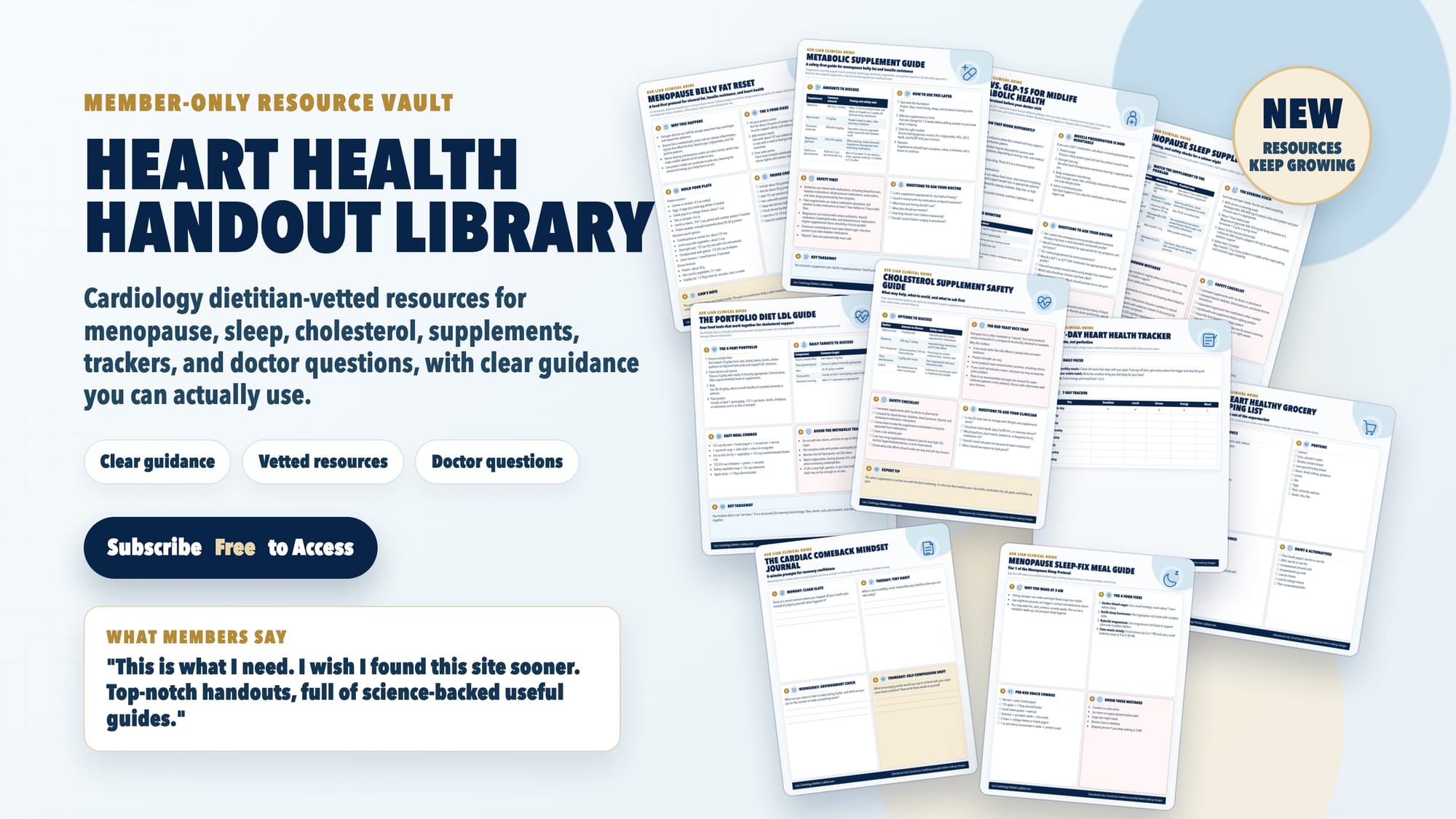
Download Vetted Clinical Handouts & Trackers
Get instant access to a growing library of evidence-based guides, food protocols, and symptom logs vetted by a cardiology dietitian. Access is completely free—simply subscribe to view.
Access Handout Library




Member discussion