
How to Get the Advanced Heart Tests Your Doctor Might Skip (And How to Advocate for Yourself)

How to Get the Advanced Heart Tests Your Doctor Might Skip (And How to Advocate for Yourself)
Written by: Lian Liu, MPH, RD, CDCES | Specializing in Cardiac & Menopause Nutrition. Reviewed and updated: June 2026.
> Direct Answer: To access advanced screening, you must explicitly request Lipoprotein(a) and Apolipoprotein B (ApoB) tests from your provider rather than relying solely on a standard lipid panel. These biomarkers identify high-risk genetic factors and total particle counts that standard LDL-C measurements often overlook.
Disclosure: Some of the links below are affiliate links. This means if you click through and take action, I may receive a small commission (at no extra cost to you). This helps support the free content on this blog while I only recommend tools and foods I truly believe in for your heart health journey.
David did everything right. At 48, he ran three miles a day, never smoked, and ate a clean, plant-forward diet. When his annual physical came back with an LDL (bad) cholesterol score of 82 mg/dL, his doctor patted him on the back. "Your heart is in great shape, David. Keep doing what you're doing."
Six months later, David was in the emergency room receiving an emergency stent after a sudden heart attack.
He was stunned. "How did this happen?" he asked his cardiologist. "My cholesterol was perfect."
The cardiologist ordered a test that David's primary care doctor had never mentioned: Lipoprotein(a), or LP(a). When the results came back, David’s LP(a) was 180 nmol/L—nearly double the high-risk threshold.
David’s heart attack wasn't a failure of willpower or diet. It was a failure of standard screening. His regular doctor had checked the standard boxes, but missed the genetic marker that was quietly building plaque in his arteries.
If you have a family history of early heart disease, or if you have suffered a heart event despite having "normal" cholesterol numbers, this guide is for you. We are going to look at the two critical heart tests your doctor is likely skipping, why they matter, and exactly how to advocate for yourself to get them ordered.
1. The Standard Panel Blindspot: What LDL-C Misses
When you get a standard lipid panel, the main number your doctor looks at is LDL-C (Low-Density Lipoprotein Cholesterol).
The "-C" stands for cholesterol. This test does not measure the actual number of plaque-carrying particles in your blood; it measures the total weight of the cholesterol carried inside those particles.
Think of it like checking the traffic on a bridge by weighing the cars rather than counting them. If you have a few giant trucks, the weight is high but the traffic is light. If you have hundreds of tiny sedans, the weight might look normal, but the bridge is dangerously crowded.
Standard screening misses the "sedans"—the small, dense LDL particles that easily slip into the arterial wall and oxidize, starting the process of atherosclerosis.
To get an accurate picture of your actual cardiac risk, you need to count the vehicles and look at the genetic design of those vehicles. That requires two specific tests: LP(a) and ApoB.
2. Test #1: Lipoprotein(a) — The Genetic Sticky Particle
Lipoprotein(a), or LP(a), is a highly inflammatory, highly genetic variant of LDL. It has an extra protein attached to it called apolipoprotein(a), which acts like velcro. It makes the particle exceptionally sticky, allowing it to easily bind to your arterial walls and promote blood clots.
The Key Facts:
- Highly Inherited: Roughly 90% of your LP(a) levels are determined genetically at birth. Standard diet and exercise modifications have only minor and variable impacts on these levels.
- Extremely Common: Elevated LP(a) is common—roughly 1 in 5 people have elevated levels, depending on the cutoff used, according to the European Atherosclerosis Society consensus statement.
- The Risk Multiplier: A level of 50 mg/dL (or 125 nmol/L) increases your relative risk of cardiovascular events by approximately 40%. Extremely high levels can quadruple your risk.
Because LP(a) is largely inherited and usually stable over life, most adults only need one accurate measurement for risk assessment, as supported by clinical research on LP(a) measurement and large-scale repeat measurement trials.
What the Guidelines Say:
Major societies now increasingly support once-in-adulthood LP(a) testing to refine cardiovascular risk assessment, including the 2024 National Lipid Association scientific statement update and the formal 2026 ACC/AHA dyslipidemia guideline.
3. Test #2: Apolipoprotein B (ApoB) — The Real Particle Count
Apolipoprotein B (ApoB) is the structural protein found on the surface of every single atherogenic (plaque-forming) particle in your blood. This includes LDL, VLDL, and IDL.
Because there is exactly one ApoB protein per particle, measuring your ApoB level gives you an exact count of the total number of dangerous particles circulating in your bloodstream.
Why It Matters:
If you are already on a statin or have achieved your LDL-C targets, your standard numbers might look excellent. However, you can still have a high number of small, dense particles carrying that cholesterol. This is called residual risk.
Measuring ApoB reveals this hidden threat, allowing you and your cardiologist to make informed decisions about whether you need more intensive therapy.
What the Guidelines Say:
The 2026 ACC/AHA dyslipidemia guideline also supports selective ApoB testing to clarify residual risk in patients such as those with diabetes, high triglycerides, cardiovascular-kidney-metabolic syndrome, or known cardiovascular disease who have reached LDL-C and non-HDL-C goals.
4. How to Advocate for Yourself: Clinical Scripts
Despite these tests being supported by major guidelines, clinical practice lags behind scientific consensus. Real-world studies show that LP(a) testing remains uncommon—often well under 1% in health-system testing trend databases and multicenter analyses of cardiovascular disease patients.
If you ask for these tests, your doctor might say, "Your standard cholesterol is fine, you don't need that," or "Insurance won't cover it."
To advocate for yourself, you can use the exact clinical guideline justifications. Here are the scripts to use during your next appointment:
The Script for requesting LP(a):
"Doctor, I would like to have my Lipoprotein(a) level measured. The National Lipid Association now recommends universal testing at least once in every adult’s lifetime to refine cardiovascular risk assessment. Since I have a family history of [mention early heart disease, heart attack, or stroke in relatives, if applicable], knowing my genetic baseline is essential for managing my risk."
The Script for requesting ApoB:
"Since I am managing my cardiovascular risk [or: since I am on lipid-lowering therapy] and we are targeting my LDL goals, I would like to check my ApoB level. The ACC/AHA dyslipidemia guidelines state that measuring ApoB may be useful in high-risk patients who have achieved their LDL targets to clarify residual risk. I want to make sure we aren't missing a high particle count."
5. What If Your Doctor Refuses?
If your doctor declines to order the tests or if your insurance refuses to cover them, you still have options. Direct-to-consumer lab testing has become highly accessible and affordable.
You can order these tests yourself online and walk into a local Quest Diagnostics or Labcorp for the blood draw:
- QuestDirect: Quest Diagnostics offers direct-to-consumer lipid and advanced panels, including LP(a) and ApoB, which you can purchase online without a physician's referral.
- InsideTracker: This personalized health platform offers comprehensive biomarker testing (including ApoB and standard lipids) along with lifestyle and nutrition recommendations based on your results.
(Note: We have no affiliation with any laboratory or testing providers. These options are shared solely as educational resources for self-advocacy.)
Most direct-to-consumer LP(a) tests cost between $30 and $50 out-of-pocket, which is a small price to pay for a lifetime marker that dictates your cardiovascular prevention strategy.
Your Action Step: Search Your History
Before your next appointment, go back through your electronic medical records or paper lab results from the last few years.
- Look specifically for Lipoprotein(a) (sometimes written as Lp(a)) or Apolipoprotein B (ApoB).
- If they aren’t there, copy the scripts above into your phone's note app.
- Send a message to your doctor's portal today requesting these additions to your next routine lab order.
Taking charge of your diagnostics is the first step to ensuring your heart health plan is built on data, not guessing.
For a complete guide on how to interpret your lab numbers and build a heart-healthy lifestyle that matches your genetics, grab your copy of The Cardiac Comeback.
Stay Ahead of Your Heart Health
Want to stay up-to-date with current science-backed nutrition tips to protect your cardiovascular future?
- Subscribe to the Newsletter: Get practical, clinical-strength tips on diet, labs, and lifestyle adjustments sent straight to your inbox.
- Get the Master Course: Secure immediate access to the Heart Disease Risk Reversal Master Course and start reversing your risk today.
👉 Join the Newsletter & Master Course here
Keep advocating for yourself.
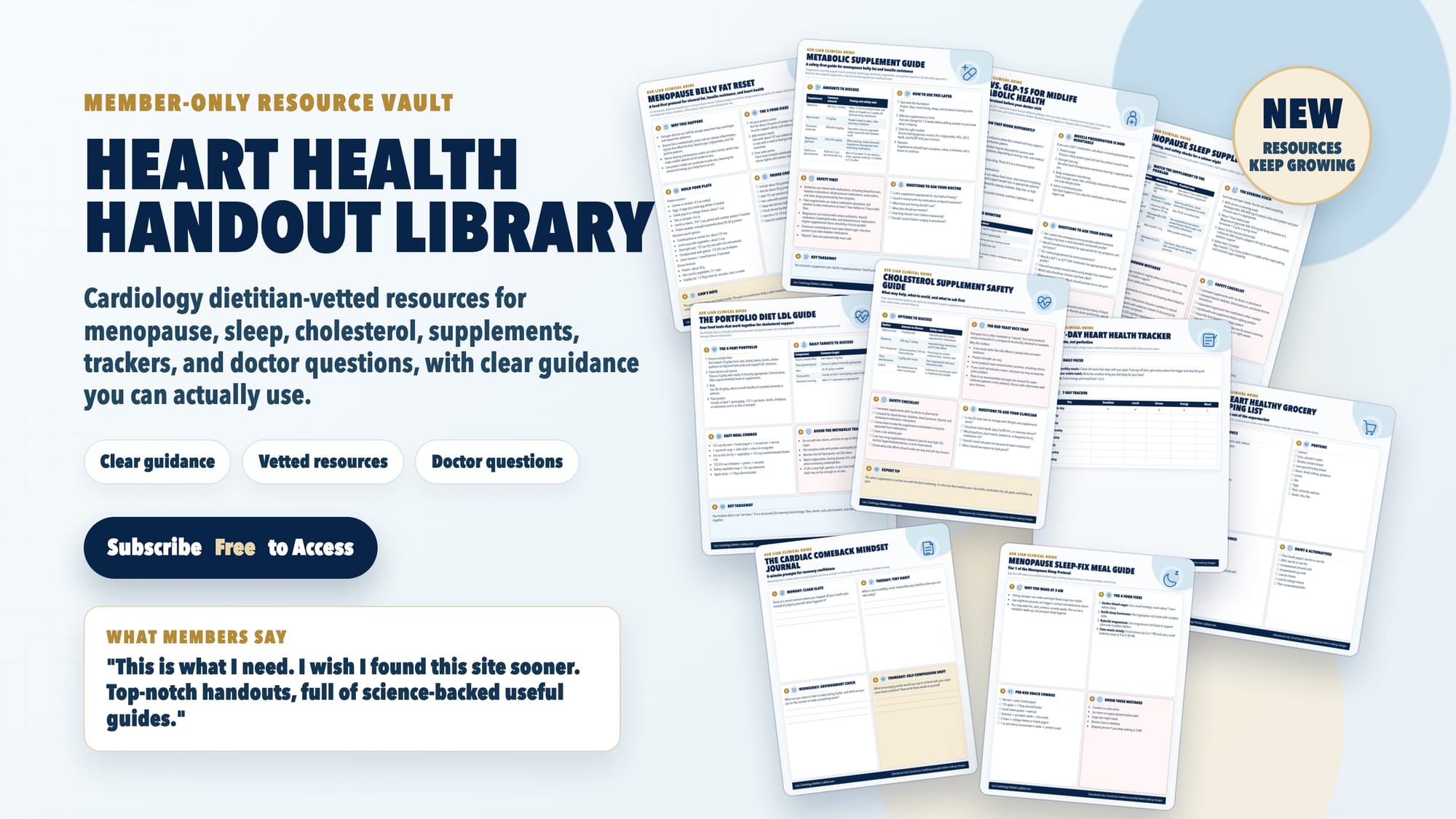
Download Vetted Clinical Handouts & Trackers
Get instant access to a growing library of evidence-based guides, food protocols, and symptom logs vetted by a cardiology dietitian. Access is completely free—simply subscribe to view.
Access Handout Library




Member discussion